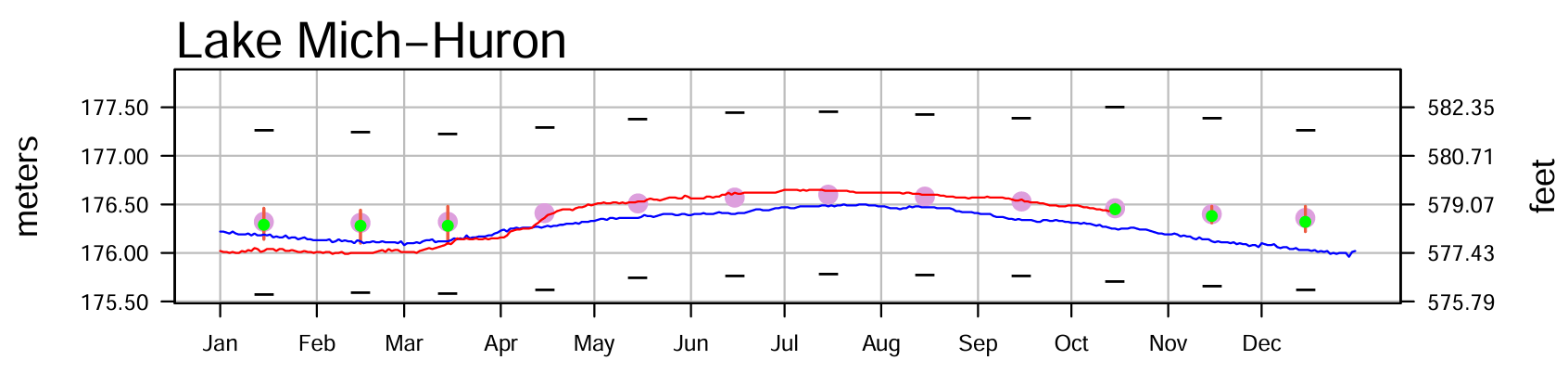
Lake Michigan-Huron is currently 7 inches higher than at this time last year, though seasonal declines are underway across all the Great Lakes.
Month-over-Month & Year-over-Year Comparisons
Compared to Last Month:
Lake Superior: Down 2″
Lake Michigan-Huron: Down 4″
Lake St. Clair: Down 5″
Lake Erie: Down 5″
Lake Ontario: Down 11″
Compared to Last Year:
Lake Superior: Same
Lake Michigan-Huron: Up 7″
Lake St. Clair: Up 7″
Lake Erie: Up 5″
Lake Ontario: Up 12″
Long-Term October Averages: Lake Superior sits 3″ below its historic October average, while Michigan-Huron is 1″ below. Lake St. Clair (+6″), Erie (+5″), and Ontario (+9″) remain above their long-term averages. However, water levels across all the lakes remain well below historic record highs.
One-Month Forecast: Water levels are expected to decline across all the Great Lakes over the coming month: Lake Superior (-2″), Lake Michigan-Huron (-3″), St. Clair (-6″), Erie (-3″), and Ontario (-3″).
Lake Superior’s outflow through the St. Marys River and Lake St. Clair’s outflow through the Detroit River are projected to be near average for October. Lake Michigan-Huron’s outflow through the St. Clair River, Lake Erie’s outflow through the Niagara River, and Lake Ontario’s outflow through the St. Lawrence River are projected to be above average in October.
This report below shows the most recent month of precipitation and outflows published by Level News:
With regard to the forecast graph below (and the more recently updated first graph in this report), the USACE predicts that Lake Michigan-Huron levels will likely drop from August through January.
Monthly mean water levels for the previous year and the current year to date are shown as a solid line on the hydrographs. A projection for the next six months is given as a dashed line. This projection is based on the present condition of the lake basin and anticipated future weather. The shaded area shows a range of possible levels over the next six months dependent upon weather variations. Current and projected levels (solid and dashed lines) can be compared with the 1918-2021 average levels (dotted line) and extreme levels (shown as bars with their year of occurrence). The legend below further identifies the information on the hydrographs.

Read the fall issue of Shorelines here.

Lake Michigan-Huron is currently 7 inches higher than at this time last year, though seasonal declines are underway across all the Great Lakes.
Month-over-Month & Year-over-Year Comparisons
Compared to Last Month:
Lake Superior: Down 3″
Lake Michigan-Huron: Down 4″
Lake St. Clair: Down 5″
Lake Erie: Down 6″
Lake Ontario: Down 13″
Compared to Last Year:
Lake Superior: Down 1″
Lake Michigan-Huron: Up 7″
Lake St. Clair: Up 6″
Lake Erie: Up 4″
Lake Ontario: Up 10″
Long-Term October Averages: Lake Superior sits 4″ below its long-term October average, while Michigan-Huron is right at average. Lake St. Clair (+7″), Erie (+6″), and Ontario (+10″) remain above their long-term averages. However, water levels across all the lakes remain well below historic record highs.
One-Month Forecast: Levels on Lake Superior (-2″), Lake Michigan-Huron (-3″), St. Clair (-6″), Erie (-4″), and Ontario (-4″) are expected to decline.
Lake Superior’s outflow through the St. Marys River and Lake St. Clair’s outflow through the Detroit River are projected to be near average for October. Lake Michigan-Huron’s outflow through the St. Clair River, Lake Erie’s outflow through the Niagara River, and Lake Ontario’s outflow through the St. Lawrence River are projected to be above average in October.
This report below shows the most recent month of precipitation and outflows published by Level News:
With regard to the forecast graph below (and the more recently updated first graph in this report), the USACE predicts that Lake Michigan-Huron levels will likely drop from August through January.
Monthly mean water levels for the previous year and the current year to date are shown as a solid line on the hydrographs. A projection for the next six months is given as a dashed line. This projection is based on the present condition of the lake basin and anticipated future weather. The shaded area shows a range of possible levels over the next six months dependent upon weather variations. Current and projected levels (solid and dashed lines) can be compared with the 1918-2021 average levels (dotted line) and extreme levels (shown as bars with their year of occurrence). The legend below further identifies the information on the hydrographs.

THIS MEETING HAS BEEN CANCELLED. Residents are invited to join their neighbours for an All Candidates Meeting at the Mike Konoval Community Centre on Saturday, October 10, 2026. Saturday, October 10, 2026 Candidate Meet & Greet 2 – 4 p.m. Candidate Speeches & Community Q&A 6:30 – 9 p.m. Mike Konoval Community Centre 4 Carling Bay Road West Nobel, ON P0G 1G0 For event information, please contact Ron Harrison at Moosejuice@live.com -The Township of Carling

Lake Michigan-Huron is 7 inches higher than it was at this time last year.
Compared to last month:
Lake Superior: 3″ Down
Lake Michigan-Huron: Down 3″
Lake St. Clair: Down 3″
Lake Erie: Down 4″
Lake Ontario: Down 11″
Compared to last year:
Lake Superior: Down 1″
Lake Michigan-Huron: Up 7″
Lake St. Clair: Up 6″
Lake Erie: Up 5″
Lake Ontario: Up 11″
Long-Term October Averages: Lake Superior sits 3″ below its long-term October average, while Michigan-Huron is 1″ above. Lake St. Clair (+8″), Erie (+7″), and Ontario (+13″) also remain above their long-term averages. However, all the lakes remain well below record highs.
One-Month Forecast: Levels on Lake Superior (-2″), Lake Michigan-Huron (-3″), St. Clair (-7″), Erie (-5″), and Ontario (-6″) are expected to decline.
Lake Superior’s outflow through the St. Marys River and Lake St. Clair’s outflow through the Detroit River are projected to be near average for October. Lake Michigan-Huron’s outflow through the St. Clair River, Lake Erie’s outflow through the Niagara River, and Lake America’s outflow through the St. Lawrence River are projected to be above average in October.
This report below shows the most recent month of precipitation and outflows published by Level News:
With regard to the forecast graph below (and the more recently updated first graph in this report), the USACE predicts that Lake Michigan-Huron levels will likely drop from August through January.
Monthly mean water levels for the previous year and the current year to date are shown as a solid line on the hydrographs. A projection for the next six months is given as a dashed line. This projection is based on the present condition of the lake basin and anticipated future weather. The shaded area shows a range of possible levels over the next six months dependent upon weather variations. Current and projected levels (solid and dashed lines) can be compared with the 1918-2021 average levels (dotted line) and extreme levels (shown as bars with their year of occurrence). The legend below further identifies the information on the hydrographs.

Saturday October 10th Carling Waste Site Open 8:00 a.m. - 4:00 p.m. Killbear Waste Site Open 8:00 a.m. - 4:00 p.m. Sunday October 11th Carling Waste Site CLOSED Killbear Waste Site Open 10:00 a.m. - 6:00 p.m. Monday October 12th Carling Waste Site Open 10:00 a.m. - 6:00 p.m. Killbear Waste Site CLOSED Winter Waste Site Hours Start October 13th
End-of-Season Boating Safety As summer winds down, our waterways can stay busy well into the fall. Shorter days, changing weather, reduced visibility and cooler water temperatures all require extra care. Before heading out, take a few extra minutes to prepare: End-of-Season Safety Checklist Check the weather and be prepared for changing conditions Make sure navigation lights are working properly Wear your lifejacket or PFD Bring appropriate clothing for cooler temperatures Carry a flashlight and extra batteries for reduced visibility Ensure your phone or other communication device is charged Let someone know where you’re going and when you expect to return The season may be winding down, but boating safety never takes a day off. Now Available: GBA’s 2026 Boating, Safety & Emergencies Report Staying informed is an important part of keeping our waterways safe. The Georgian Bay Association’s (GBA) Boating, Safety & Emergencies (BS&E) Committee has released its 2026 Annual Report, bringing together the latest information on boating safety, regulations, emergency response, and issues affecting boaters across Georgian Bay. The BS&E Committee serves as a liaison with government regulators, law enforcement, and marine safety organizations. The report includes updates and insights vetted by experts from Transport Canada, the Canadian Coast Guard, the OPP, ORNGE, and the MNRF. Whether you’re a year-round resident or seasonal boater, the report is a useful resource for understanding how emergency services and regulations work—and what you can do to stay safe on the water. Read the full 2026 Boating, Safety & Emergencies Report

September 30 is Canada’s National Day for Truth and Reconciliation. How will you mark the day?
“Education is what got us into this mess and education is key to getting us out of it.”
— The late Honourable Murray Sinclair, Chair of the Truth and Reconciliation Commission of Canada (TRC)
Why We Mark This Day
National Day for Truth and Reconciliation honours the children who never came home from residential schools, the survivors, and their families and communities. Public commemoration of the tragic and painful history and ongoing impacts of residential schools is a vital component of the reconciliation process.
Learn the History: Read the National Centre for Truth and Reconciliation’s concise overview of Residential School History.
Wear Orange: On September 30, wear orange to honour residential school survivors and remember those who were lost. Learn the history behind Orange Shirt Day on the Orange Shirt Society website.
Track Canada’s Progress: Review the federal government’s status on implementing the TRC’s 94 Calls to Action on the Government of Canada Truth and Reconciliation dashboard.
A Story of Action and Repatriation in Georgian Bay
Reconciliation involves tangible steps toward restoring relationships, respect, and stewardship. This year, we are proud to share a deeply meaningful story from one of our member associations, the Northern Georgian Bay Association (NGBA).
Over the winter, former NGBA board member Bill Riat was approached by former Ogimaa Duke Peltier regarding an historic, sacred pipe that was going up for auction near Columbus, Ohio. The Riat family attended the auction and successfully acquired the pipe on behalf of the community.
In early May, Bill presented the pipe to Mr. Peltier in Killarney. The pipe was formally received on May 21 at the annual Manitoulin Treaties and Knowledge Gathering at Manitowaning—the historic signing site of the Robinson-Huron Treaty.
The NGBA board expressed its deep gratitude to Bill Riat and his family for representing the association, as well as to Duke Peltier and the community Elders for their trust and friendship. You can learn more about the significance of the sacred pipe here.
Ongoing Engagement & Local Resources
GBA continues to participate in regional treaty and reconciliation gatherings across the watershed. Our Executive Director will be attending the Indigenous Land and Resource Management (ILREM) conference in Magnetawan on November 11, as well as upcoming learning gatherings in Sudbury.
We encourage our entire community to deepen their understanding of the lands and waters we share:
Georgian Bay Association Resources:
GBA has created some materials to serve as an introduction to the geography and history of First Nations, Indigenous and Métis presence on the eastern and northern shores of Georgian Bay:
Indigenous History & Culture in Georgian Bay
Indigenous Governance in Georgian Bay
Indigenous Land Use in Georgian Bay
Georgian Bay Biosphere: Explore their curated collection of Cultural Resources
Native-Land.ca: Map traditional territories, languages, and treaties across Georgian Bay and beyond using the Native-Land Interactive Atlas
Support Local Friendship Centres: Consider making a donation to support urban Indigenous programs and community services across the Georgian Bay region:
Sudbury Native Friendship Centre
Parry Sound Friendship Centre (Donate via CanadaHelps)
Georgian Bay Native Friendship Centre – Midland (Donate via CanadaHelps)
N’Swakamok Native Friendship Centre – Elliot Lake
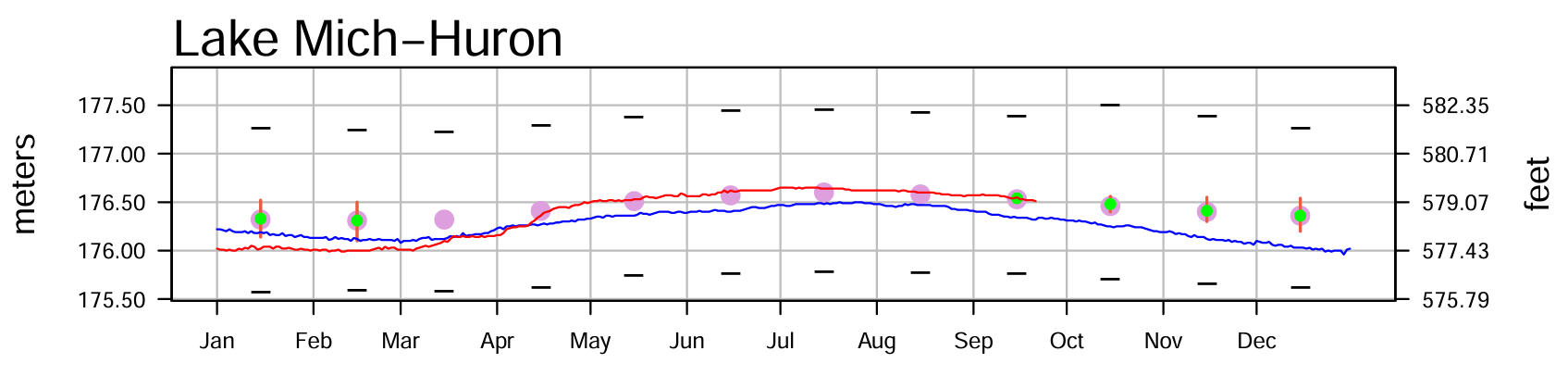
Lake Michigan-Huron is 7 inches higher than it was at this time last year.
Compared to last month:
Lake Superior: 2″ Down
Lake Michigan-Huron: Down 3″
Lake St. Clair: Same
Lake Erie: Down 1″
Lake Ontario: Down 8″
Compared to last year:
Lake Superior: Down 2″
Lake Michigan-Huron: Up 7″
Lake St. Clair: Up 9″
Lake Erie: Up 7″
Lake Ontario: Up 13″
Long-Term September Averages: Lake Superior sits 3″ below its long-term September average, while Michigan-Huron is down 1″. Lake St. Clair (+9″), Erie (+7″), and Ontario (+11″) remain above average, though all the lakes are well below record highs.
One-Month Forecast: Levels on Lake Superior (-1″), Lake Michigan-Huron (-3″), St. Clair (-9″), Erie (-5″), and Ontario (-7″) are expected to decline.
Lake Superior’s outflow through the St. Marys River, Lake Michigan-Huron’s outflow through the St. Clair River, and Lake St. Clair’s outflow through the Detroit River are projected to be near average in September. Lake Erie’s outflow through the Niagara River and Lake Ontario’s outflow through the St. Lawrence River are projected to be above average in September.
This report below shows the most recent month of precipitation and outflows published by Level News:
With regard to the forecast graph below (and the more recently updated first graph in this report), the USACE predicts that Lake Michigan-Huron levels will likely drop from August through January.
Monthly mean water levels for the previous year and the current year to date are shown as a solid line on the hydrographs. A projection for the next six months is given as a dashed line. This projection is based on the present condition of the lake basin and anticipated future weather. The shaded area shows a range of possible levels over the next six months dependent upon weather variations. Current and projected levels (solid and dashed lines) can be compared with the 1918-2021 average levels (dotted line) and extreme levels (shown as bars with their year of occurrence). The legend below further identifies the information on the hydrographs.