The results of the 2050 State of the Great Lakes Report (SOGL)—the authoritative assessment of the health of our waters—classify the Lake Huron/Georgian Bay ecosystem as “Fair to Good” with an “Unchanging” trend. 
According to the report, the Lake Huron basin remains a reliable source of high-quality drinking water and offers excellent opportunities for swimming and recreation. However, the report highlights several key “Fair” and “Poor” indicators that demand our attention:
Nutrients and Algae: While offshore phosphorus is stable, nearshore areas are prone to nuisance algal growth (Cladophora). Specifically, the southern end of Georgian Bay remains a focal point for these blooms.
Invasive Species: This sub-indicator remains “Poor.” Filter-feeding Quagga Mussels have significantly lowered productivity in offshore waters and are the primary driver behind localized algae growth near our shores.
Fish and Wildlife: Fish-eating and colonial-nesting waterbirds are currently assessed as “Poor” due to low populations. While Lake Trout and Walleye populations are stable or improving, consumption advisories remain in effect for certain species due to lingering contaminant levels.
Coastal Wetlands: Georgian Bay and Lake Huron contain 30% of all Great Lakes wetlands. These are in Fair to Good condition, though northern regions generally show better health than southern areas, which face more stress from agricultural runoff.
Read the full “report card” here.
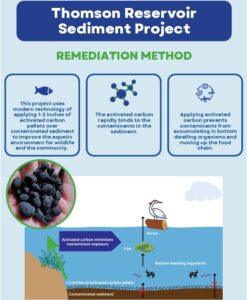
Although few presentations addressed Georgian Bay directly, a recently completed project at the Thomson River reservoir on Lake Superior was of particular interest. Researchers deposited more than 20,000 tonnes of activated carbon, which will bind to contaminants in the sediment and prevent their movement up the food chain—a technique that may eventually prove vital for our own industrial harbours!
Read more about the potential effects of activated carbon here,